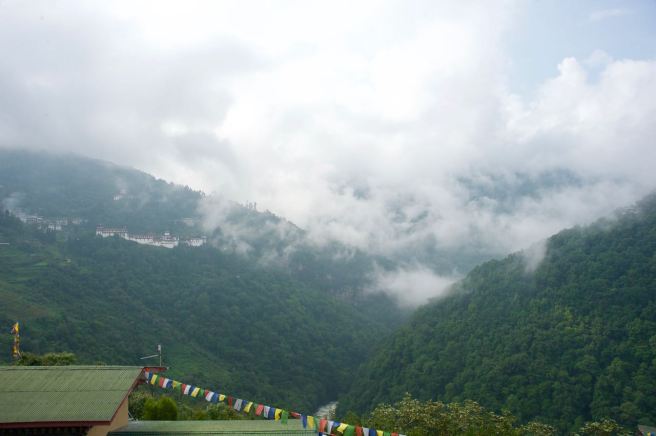
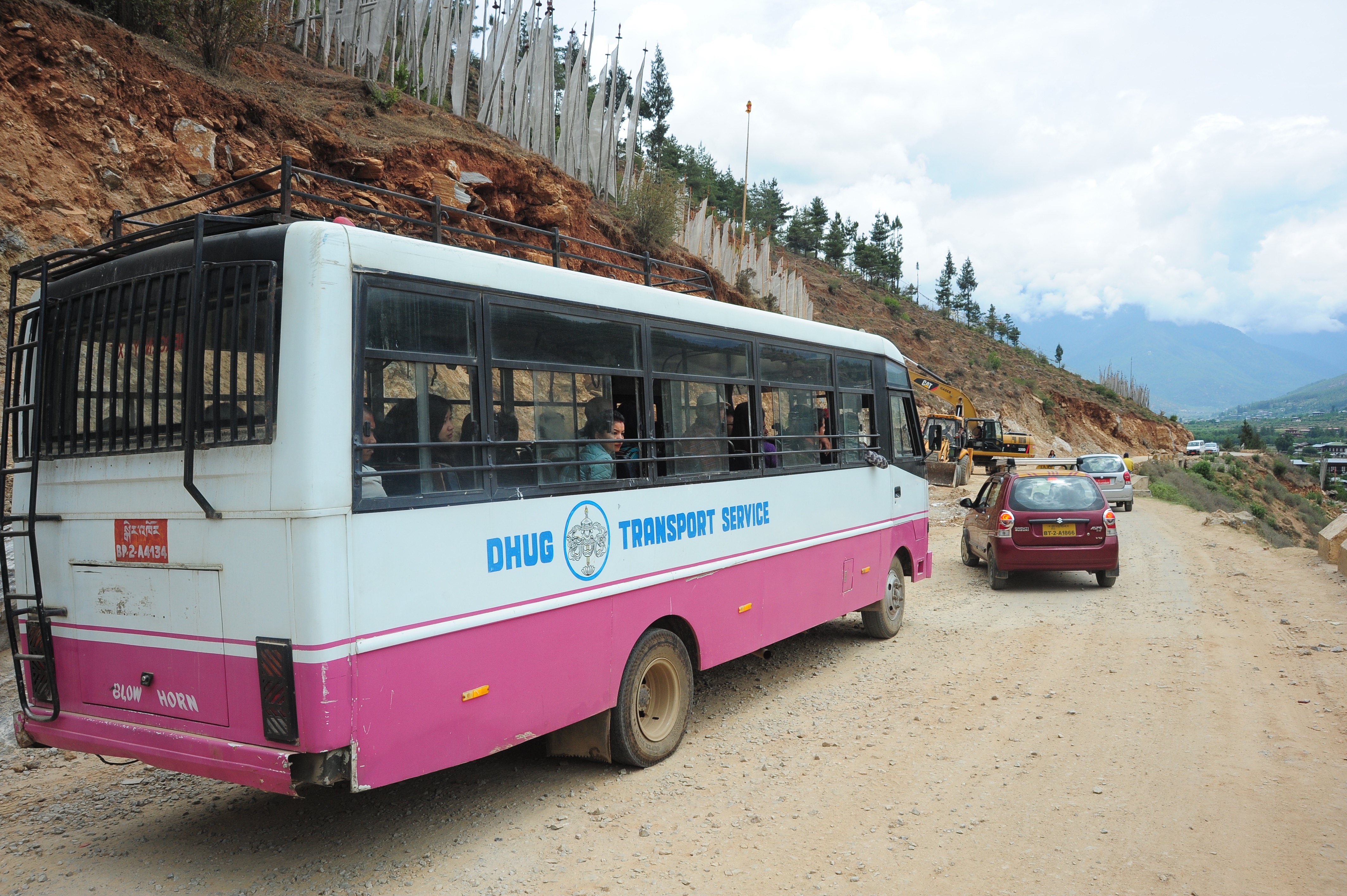
The bus rides high about the valley floors of central Bhutan as we wind our way along the mountains of central Bhutan. The forested mountains are often covered in fog. The mist seems to gather on the roads and in the trees, surrounding us in a sense of calm, quiet. If you listen carefully, you can hear, beyond the drone of the diesel engine, the deep quiet of the region. A stillness rests on the shoulders of these massive hills.
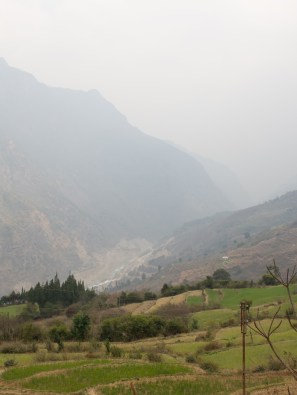
In a couple of places on the journey, one can see the road far across the valley. At one place in particular, not far from Trongsa, you can see the road contour around the mountain side, turning in the crook of the folds in the hills, rising up again on the other side of the valley. The road stretches for miles and yet, if you had a bridge or really long rope swing, you would quickly make it across, cutting hours off the drive.
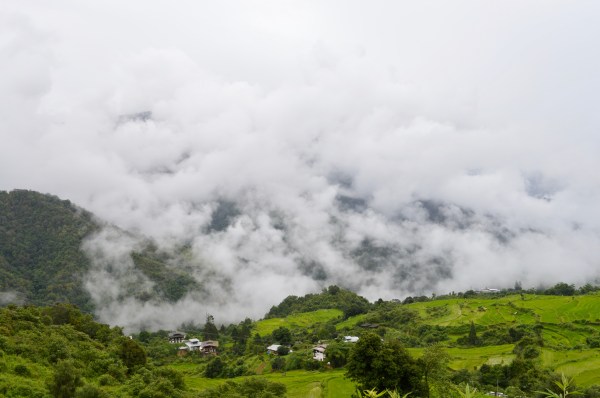
If you look carefully, you can see the road on both sides of the valley as the river runs through it.The clouds and mist in Trongsa
Suddenly, on one side of the road, you notice a collection of houses just before you reach Trongsa. This small community, Tsangkhap, clings to the sides of the hills, fields cut out of the hillside below the houses. Dirt roads meet the main road here, with fields and farms dotted along these ancient tracks.
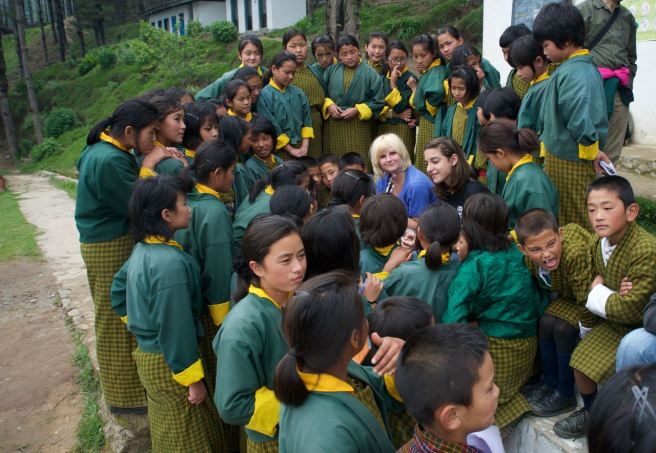
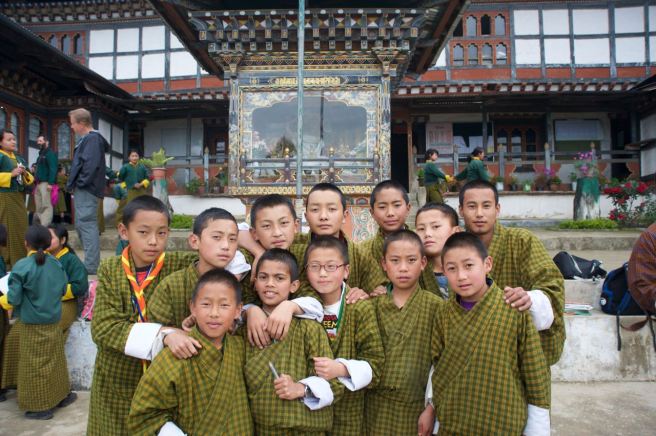
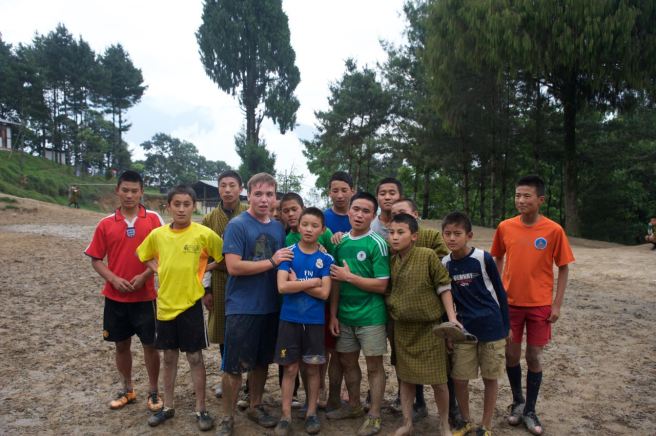
Here, in Tsangkhap, we stop at the Trongsa Central School, renamed for its now significant role in teaching students of all ages who live nearby. Year after year we come to the school to meet with students. The school grounds are humble and the mood is high as we walk onto campus. As soon as we are spotted an energy runs through the community and we gather in the open area in front of the school to hang out.
Lots and Lots of Questions…especially about blonde hair.Really Wanting a PicturePlenty of Time to Play a Soccer Match
After our time at the school, we walk into the village, visiting our guide’s home. His mom is there preparing tea for us as we walk into the house. The fields surrounding the house are verdant with deep hue or green, the wind gently blowing the tops of the wheat.
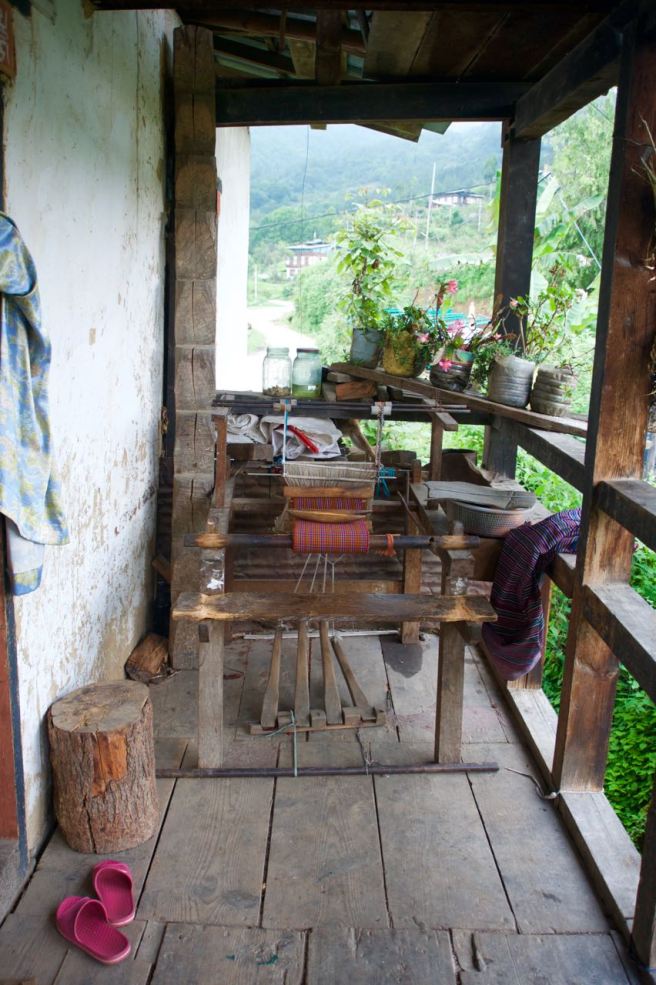
Into Namgay’s Family HomeThe Loom on the porch ready to use…
We are served tea and sit on the floor, relaxing or a moment or two. The tea is black, with a little milk from the cow, and a small handful of rice, dried and baked. The drink is filling and the taste is sweet. We talk about the day, hear Namgay’s stories about the yeti who lived in the forests nearby, and the tale of a yeti who married a man. Our time in this place is all too brief as we head out again, walking deeper into the village.
From the dry valley of Punakha and Wangdue Phodrang, the main road east winds its way up to commanding heights of the foothills of the Himalayas. The altitude gains on the journey are impressive. The mountains rise sharply above the valley floor and the road turns and curves over and over again.
On this section of the drive, the landscape changes dramatically and quickly. In places, the road is well-maintained and the drive is easy. In some spots, the road is very narrow and in the event of an accident or broken down vehicle, things come to a stop. For folks used to moving quickly, making time on a tour to get from point A to point B, this road is not for those folks. Travel in Bhutan is more than just getting to the next view or stop; being in Bhutan is about accepting the pace of life that is about experience and what I call calm abiding….accepting what comes in whatever way it comes. Just remember, it’s all about the experience, the friendships and connections made and not about ticking off boxes of “been there, done that.”
On the road through Wangdue-Phodrang.Hazy skies as we leave Wangdue headed for Trongsa.
Getting REALLY close.
Once above the valley floor, the winding, coursing track leads to small villages, many on the very side of the road. Houses are dotted along the way and, near the top of the climb, a cafe that serves black tea with milk (milk tea) and small biscuits or crackers. The place is comfortable and quiet even with a crowd. Tables inside and outside the building are scattered with some comfy chairs and places to just be. The moment out of the bus and in the cafe is a kind respite from the road.
Relaxing in a cafe, on the road to Trongsa.
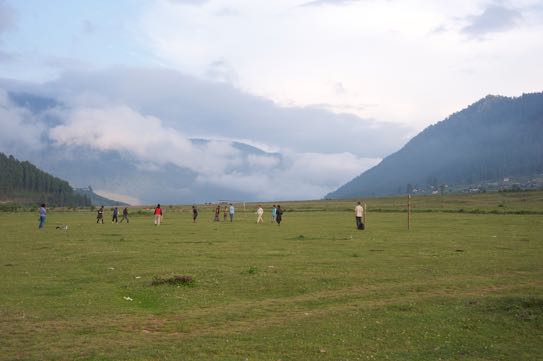
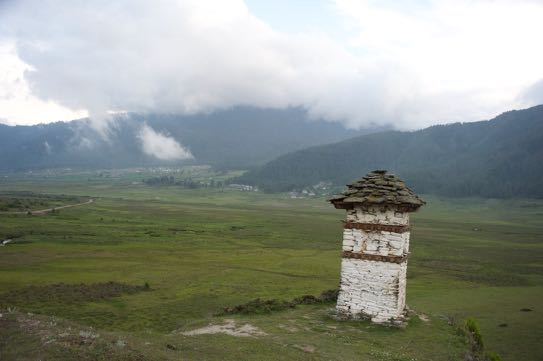
As we pile back into the bus, we settle in for the road to Tsangkhap and Trongsa. The din of the bus engine whines as we travel around hills and through dense forest. Along the way is the turn off to the Phobjikha Valley and the absolutely stunning vista, winter home to the black necked-crane. If you are lucky, a mated pair will remain in the valley and a stay in the area will allow you to hike across the valley floor, seeing the vistas and mountains that rise sharply above the small stream that meanders through the grasses hugging the rolling hills.
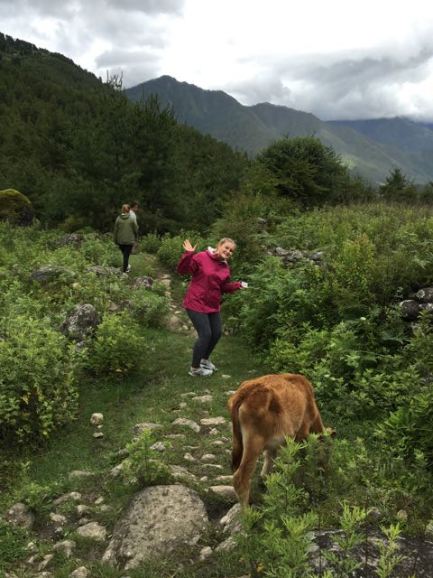
Our hike through the valley was absolutely perfect as the weather had just cleared and we walked through the pine trees that dot the landscape above the valley. Our trail is roughly maintained and in places disappears into the pine needles below our feet. No matter, you can see the valley stretched in front of you as you wander.
….and if you are really lucky, you’ll join a soccer match.Hiking Through the Phobjikha Valley
A stay in the valley is serene and having the chance to visit the local Nature Center and learn about the migration of black-necked cranes is worth the effort to reach this place.
In and around Thimphu, we spend our first full day in the country visiting the National Zoo, the craft and farmer’s markets, and walks through town to see the National Library and an Art School. On the way to the National Zoo to see the Takin, we stop along the way to see the mountainside carving and painting of Padmasambhava. Literally everywhere in the country, travelers find the signs of Vajrayana Buddhism. If you look closely enough on roadsides throughout the country, you’ll find evidence of Buddhism. It is, literally, everywhere. One is immersed in the heart of Vajrayana.
Padmasambhava carved into the hillside on the road to Tango Buddhist University.
Around Thimphu, a visitor quickly discovers that the city, a bustling hub of human interaction and business, is small, confined to a valley quickly filling with apartments and businesses. A glance at Kuensel, one of the Bhutanese newspapers, reveals that people are moving to the city in droves. The air of hustle and bustle is clear to anyone who travels to this distant capital city. The population of Bhutan, around 800, 000 folks, work in primarily agricultural settings and the pull to leave the land and move to the city is strong. As a money economy spreads across the country and into remote agricultural areas in the country, the push to make money, to have cash in hand, is a strong incentive for a move into cities. While I am not a statistician and have not measured the change in numbers, the efforts to build more housing in Thimphu and the rise in population is obvious to any observer of Bhutan who has visited the country a few times. Thimphu hums with activity and is driving internal immigration. The impact will be, I imagine, profound on the country as the years progress.
In fact, in the evenings, walking around Thimphu you will find the whole town out and about. The streets are filled with people. Impromptu veggies stands pop up, stores are open and people are gathered in the street talking, laughing, going somewhere. I talked to a group of what looked like high school young men walking with a soccer ball in hand, asking them about their night time activities. They were all headed to a friends house to watch a match on TV (this friend had satellite TV and they didn’t). Then they wanted to know who my favorite Premier League team was and I asked, in a joking way, if there were ANY good teams in the league. They all looked shocked at my question! Then I said that it didn’t matter anyway because Germany was going to beat everyone anyway. They laughed out loud at this assertion and, as a group, walked away, arguing about the Premier League teams.
I stopped to talk to a woman selling what looked like turnips (or radishes) and asked about her produce. She told me she was worried that I might draw too much attention to her as the sale of vegetables at night was not allowed. I did not pry and asked about her crops…she grew them in her back yard and tried to make a little extra money. I asked about price and she said she sold the plants for 1 ngultrum each…that’s 1/65 of a dollar. (about 2 cents or so).
Finally, a few students and I were looking for live music, to hear music in Bhutan. We wandered in and out of a few clubs and asked folks about music. They directed us to a very small room in the basement of a building. With no markings on the door, we opened it only to find a group of guys sitting around a small table eating bowls of food. I asked, “Are you playing music in here?” They all laughed loudly. I laughed and they laughed at my laugh. I closed the door and moved on, chuckling along the way.
The road out of Thimphu winds slowly up to Dochu-la Pass at 3,100 m. The climb takes you through a heavily forested landscape with an occasional hillside cleared with houses dotting the landscape and farmers plying their craft in fields just below their houses. Some of these villages are perched precariously on these mountains and hills as the terraced fields surround the house. Seen from a distance, these communities appear idyllic as white-painted walls offer a striking view. The reality is much more challenging for many families as folks try to make ends meet growing Bhutanese red rice, millet, and other grains. Many of these communities thrive on the crops they harvest, selling their wares in markets that pop up on roadsides and in villages.
Small Villages in the Distance
Bhutan travel is a trek along this single main road that crosses the country from west to east. The black asphalt road contours around the mountainsides of the country, goes up and over a series of passes (like Dochu-la Pass) of over 3000 meters and into valleys scattered across the country. Along the roadway are a wide variety of flora and fauna that includes everything from rhododendron forests to alpine heights stretching into the distance. Houses dot the landscape along this road, as you can see, and folks are seen walking along the road for almost its entire length. One of the jokes in Bhutan is that only one stretch of road is straight, a one mile or so piece of road in Bumthang.
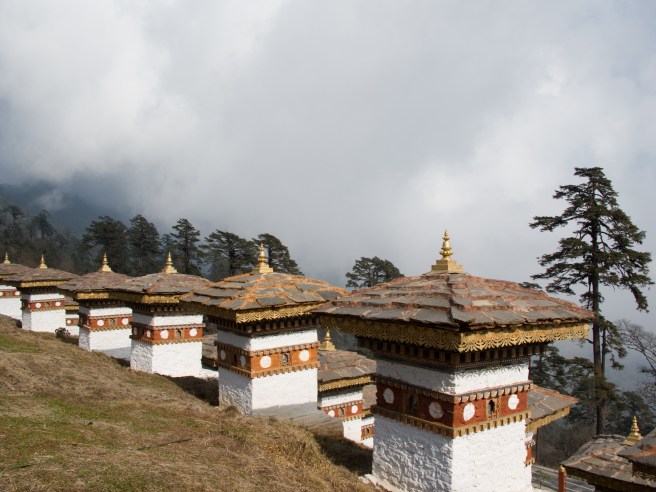
Once at the top off Dochu-la Pass, a small temple, Druk Wangyel Lhakhang, and visitor center is situated along the road. In the very center of the road on the top of the pass are a collection of 108 chortens in honor of Bhutanese soldiers killed in a battle against insurgents along the southern Bhutanese border with Assam. The stop at the top of the pass is a welcome rest from the winding roads just below and to come.
Druk Wangyal Chortens on Dochu-la PassLooking down from the temple on the pass; notice the road is divided around the Chortens.
On our stop, we pause for tea in the small Druk Wangyel cafe. We sit at tables outside as the clouds swirl around us. A kind of fog engulfs the pass and we are surrounded by these tiny droplets of water.
Enjoying Tea amid the clouds of Dochu-la PassThe Cafe
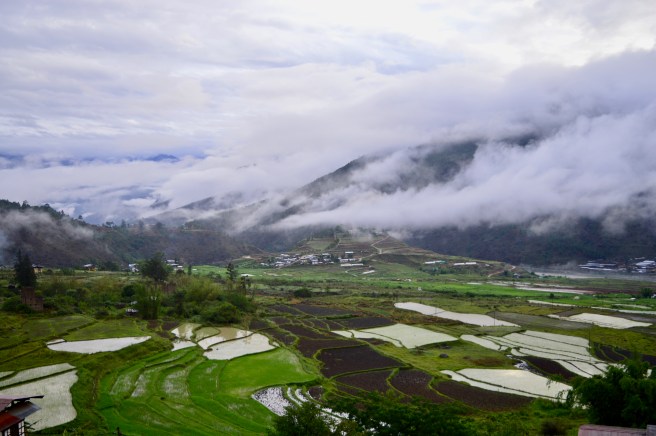
The long ride down the from the pass winds around the the mountain sides toward Punakha, Lobesa, and the Puna Tsang Chu river that flows through both Punakha and the Wangdue Phodrang districts in this part of Bhutan. As the bus descends into the valley, temperatures rise and the valley floor, is much drier than the virtual rainforest of the slopes of the mountains above it. Rice fields abound and these fields, irrigated by the various river systems in the area, yield bright green crops of Bhutanese red rice.
Looking Across the Valley toward the Temple of the Divine Madman covered in clouds.
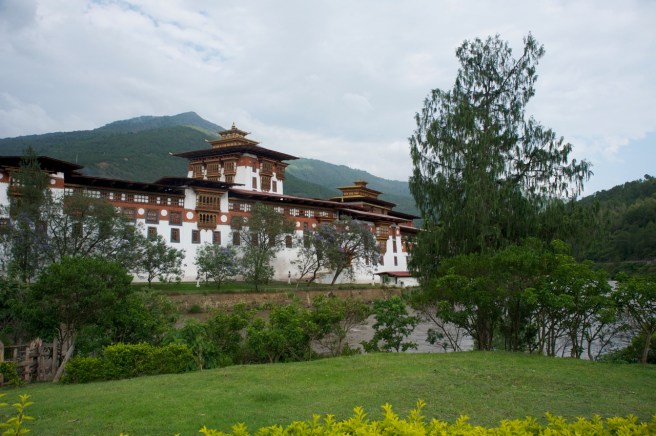
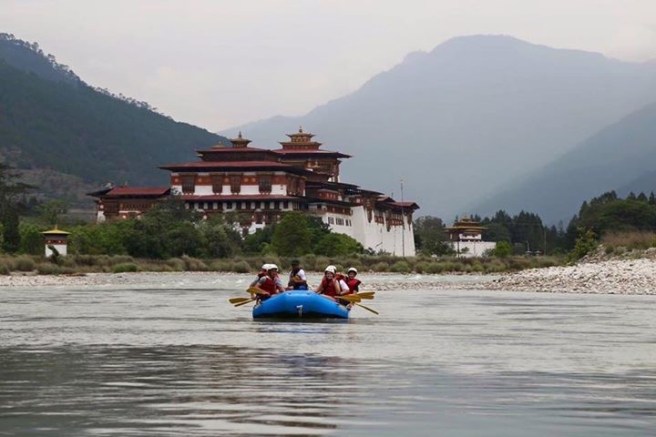
Once on the valley floor, we make our way to Punakha Dzong, one of the most remarkable places in the country. This former fortress protected Bhutan from raiding armies from Tibet. The walls of the Dzong rise high above the valley floor as the Mo Chu and Po Chu rivers merge just at the base of the structure.
Punakha Dzong above the Mo Chu river.The winners of the race…below Punakha Dzong
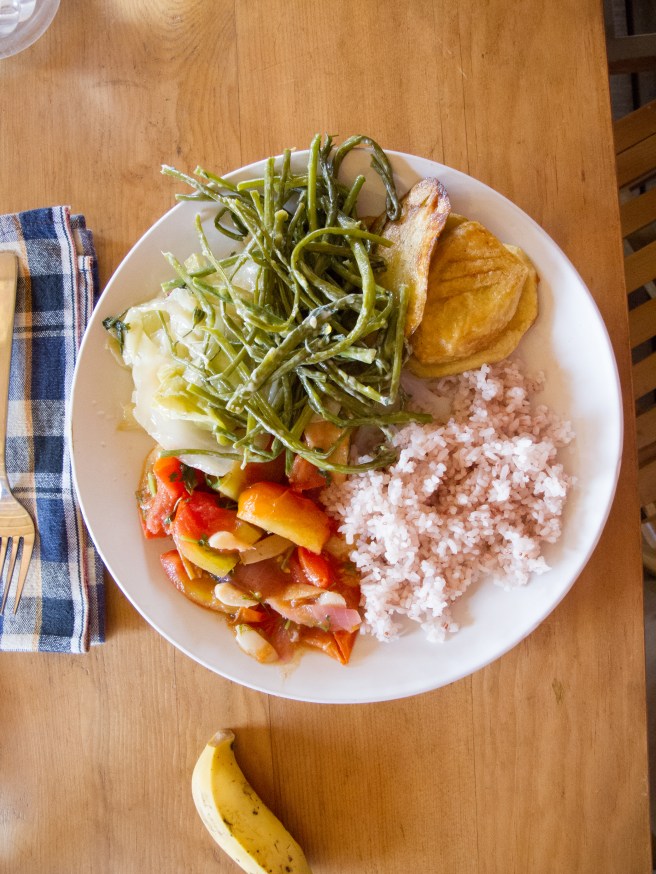
Our day of driving and site seeing is coming to an end and we make our way back to Lobesa and the Lobesa Hotel. We rest, relax, and share stories around the table of our adventures over plates of red rice and veggies.
plane, I took my first tentative steps onto the tarmac in Paro, Bhutan in June 2015. The air was moist as a recent rain storm had blanketed the town and glimmers of light pierced the clouds above dancing along the hills and trees behind the airport buildings.
Once on the ground, I walked directly into the waiting area, prepared to show my visitor’s visa and passport. The open hallway is decorated in vivid colors and images of past and present monarchs of Bhutan hang above the entryway. The open area funnels people toward the wooden desks where officials are waiting to scan documents and check visas. The immediate feeling is one of quiet and kind efficiency. Smiles are abundant, and the feeling I got was one of an easy going, professional attitude from the staff.
The initial process of entering Bhutan is very efficient and visitors are ushered into a separate room to wait for baggage. Kiosks for exchanging money are here and my recommendation is that exchanging money, now, is the best course of action. Currencies are exchanged for Ngultrum. It is important to remember that Ngultrum are not exchanged on open, currency exchanges anywhere outside of Bhutan. (Although I have not traveled through India to Bhutan and it might be different from Indian banks)
Bags come quickly and the final customs check is made as an additional security scan is necessary to enter the country.
As I walk out of the building, I am met by Namgay, our guide from Illuminating Tours. His friendly hello and welcoming attitude is noted by all of the group I am with. Instantly we feel relaxed after two days of travel from the U.S. to this country in Asia.
Gathering our things, Namgay and our driver Suba load the bags into the vehicle, a small bus with comfortable seats for about twenty folks. We are ten travelers on this trip and have room to spread out. We begin our experience in Bhutan driving out of the airport and then around the grounds and into Paro town.
Namgay (in the black Go)
Our goal, tonight, is Thimphu, the capital city. We head out onto a dirt roadway and then onto a divided highway with passing lanes on some parts of the road. We travel through a canyon as mountains on both sides of the road rise up to frame the walls of the drive. The hills are touched with mostly pine trees. The area is dry, very much like the place we are from, New Mexico. The hills around us, in fact, look almost exactly like our home. Maybe that is why we are all at ease with this trip, one that we have experienced in some way back home.
The Road to Paro.
The road is crowded with vehicles on this morning and with wind our way through the hills and along a river toward the capital. After about an hour, buildings rise up along the roadside and the going gets slower as we make our way into the city. On one side of the road a new car dealership, bright and modern, sits next to a building constructed with bamboo scaffolding. As the road gets narrower in the town, the area bustles with folks walking along the side of the road. Most folks, in traditional dress, line the streets as we make our way into the interior of the city.
Signs of construction are everywhere and those of us who have visited before notice the dramatic changes to the city. Apartment buildings, stop fronts, all kinds of structures rise on the hills in the town.
As we wind our way in to the city proper, we pass the one traffic stop, a police officer directing cars along the roadway, dogs laying in the street, the hurried-slow pace of this hub in Bhutan. We wind our way back and forth along the streets and finally head up a hill toward the giant Buddha being built above the city. As we make our way up, up, up to the structure, the clouds cover the sky and a grey pall rests over the Buddha. Wisps of fog dance around his head, standing about 50 to 75 feet above us.
The Buddha Above Thimphu
The gold of the statue shines with the glint of water even in the grey of the cloud cover. Looking out across the Thimphu valley, the din of construction is distant, and the city looks and sounds much more peaceful than it is. The platform we are standing on is being tiled….a huge undertaking. We walk from end to end and count hundreds of steps. The platform will eventually serve as a ceremonial area with hundreds gathered for religious ceremonies.
Our group takes numerous pictures and we marvel at the architectural achievement of this place. The Buddha, serene, sits behind us as we take pictures of the group. One member, Layla, leaps in the sky as happiness grabs her. We all laugh at the spectacle and realize, maybe for the first time, that we are really and truly in a place that is unique, special and wonderful. Someone wonders out loud what other wonders the remaining day and the following ones will bring.
As the year changed to 2018, the trip to Japan and Bhutan comes into focus. The start of the flight search begins in earnest. Daily updates come across my laptop from a few websites: Kayak, Vayama, Cheap-O-Air, and Justfly. You can find a wide variety of web apps and tools to track down the cheapest flights; in fact, that’s not the challenge of traveling to Asia. The challenge is finding the right combination of flights on the best airlines.
Out of LAX, China Eastern has a very low price for flights to Asia. The problem is that the airline has pretty awful ratings out in the internet land. On the website Skytraxx, many negative reviews of the airline abound. I’ve been hesitant to take the cheapest path to Asia considering the timing involved in travel across the globe! One missed or delayed flight can completely transform a trip the point that the huge chunks of travel have to be changed.
For this summer’s trip, I’ve nailed down a few pieces which include a trip to Hiroshima and Miyajima via bullet train and ferry. The visit to Hiroshima should be on everyone’s list of places to see. A visit to this city offers understanding of the destruction that came with the atomic bomb and the suffering of the individuals who faced that trauma. This awareness is an important part of understanding world history and the significance of the bomb in defining U.S. and Japanese policy.
For our Thailand piece of travel, we will be leaving the city via the Don Mueang International Airport. We will stay across the street from the airport and fly direct to Osaka, Kansai Airport. The nice part of flying into Osaka is that we can take a very short train ride into Kyoto (just 45 minutes) as opposed to the 3.5 hour train ride from Tokyo. I’ve been to both Narita and Kansai, and prefer Kansai as a way to reach the southern part of Japan quickly.
Finally, in terms of Bhutan, our plans are coming together. If things work in our favor, we will travel to Mongar and Lhuntse in the far eastern part of Bhutan. That trip will depend on road conditions, road construction, and time….going anywhere in the country takes time on the road…winding around the mountainside, to villages and communities far from the cities of Paro and Thimphu. The drive and the distance IS worth it as we experience the country in a way few folks have the chance to see.
If you are on the trip and reading this blog, it’s time to get things organized; passports, vaccinations, etc. Things move quickly this Spring and before you know it, we will be flying across the globe!
Riding the bus from the terminal in Bangkok, Suvarnabhumi Airport, the air-conditioning is cold, blowing hard against the heat of the city. For what seems like an hour, we ride to the far end of the runway to find our Bhutan Airlines plane waiting on the tarmac. Once the bus arrives, we climb the stairs to board the plane. Hopefully, it won’t be raining as we make our way onto the plane.
We are greeted with kind folk, welcoming us onto the flight and directing us to the proper seat. The excitement is at a fever pitch, imaging travel into one of the most remote kingdoms in the world, a trip very few have taken.
As we settle in, we get ready for our trip with a first stop in India and the final destination, Paro Bhutan. We take off and head around the Andaman Sea toward India, landing in Kolkata, a huge trade port in eastern India. The stop is short and we soon take off again to Bhutan.
If we are lucky, the clouds part enough for us to see Mt. Everest in the distance as we fly into far western Bhutan. The plane descends through the clouds flying just above the mountain tops into the country. Unlike many flights in the world, the Bhutan flights huge the mountainsides, following the contours of the mountains as the plane descends into the Paro valley. At the last minute, the plane makes a sharp descent to the runway and a very quick stop.
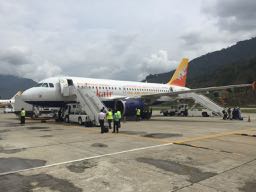
The flight is like nothing most folks have ever experienced and the exhilaration is real. We walk off the plane much like we came aboard, walking down stairs on the tarmac. We make our way into a small building and the customs check before walking into the kingdom of Bhutan for the first time.
On the Tarmac in Bhutan
After a brief bag and passport check, we exit the building and meet our guide, Namgay. For the next week or so, he will lead us across the country and to a wide variety of places that reveal the unusual and wonderful quality of Bhutan. By the time we are finished, we will never want to leave!
The flight into Bhutan is amazing! Take a look at this video and let me know what you think!
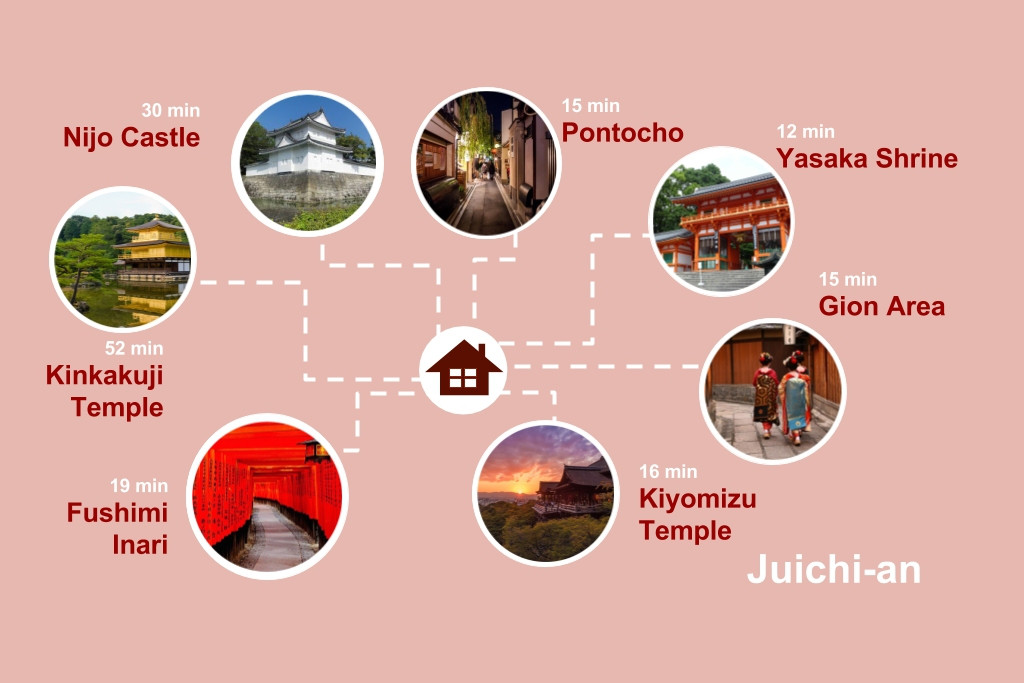
As you step off the train in Kyoto, the people and the station overwhelm you. Hundreds of folks traveling to destinations all over Japan are moving through this train station in the center of the city. After our 45 minute ride from Kansai airport, we head toward the south exit to find Bus #100. We hop on the bus and pay using our bus passes and head west, toward the Higashiyama neighborhood and the rows of traditional Japanese homes called Machiya. After a winding walk through the neighborhood we look around for a small alleyway that opens into a small courtyard of twelve houses….at the end of the courtyard, we find our spot, Juichi-an, number 11.
This particular house is managed by a wonderful company Windows to Japan. These folks are easy to work with and provide excellent services to visitors in and around Kyoto.
Higashiyama Area
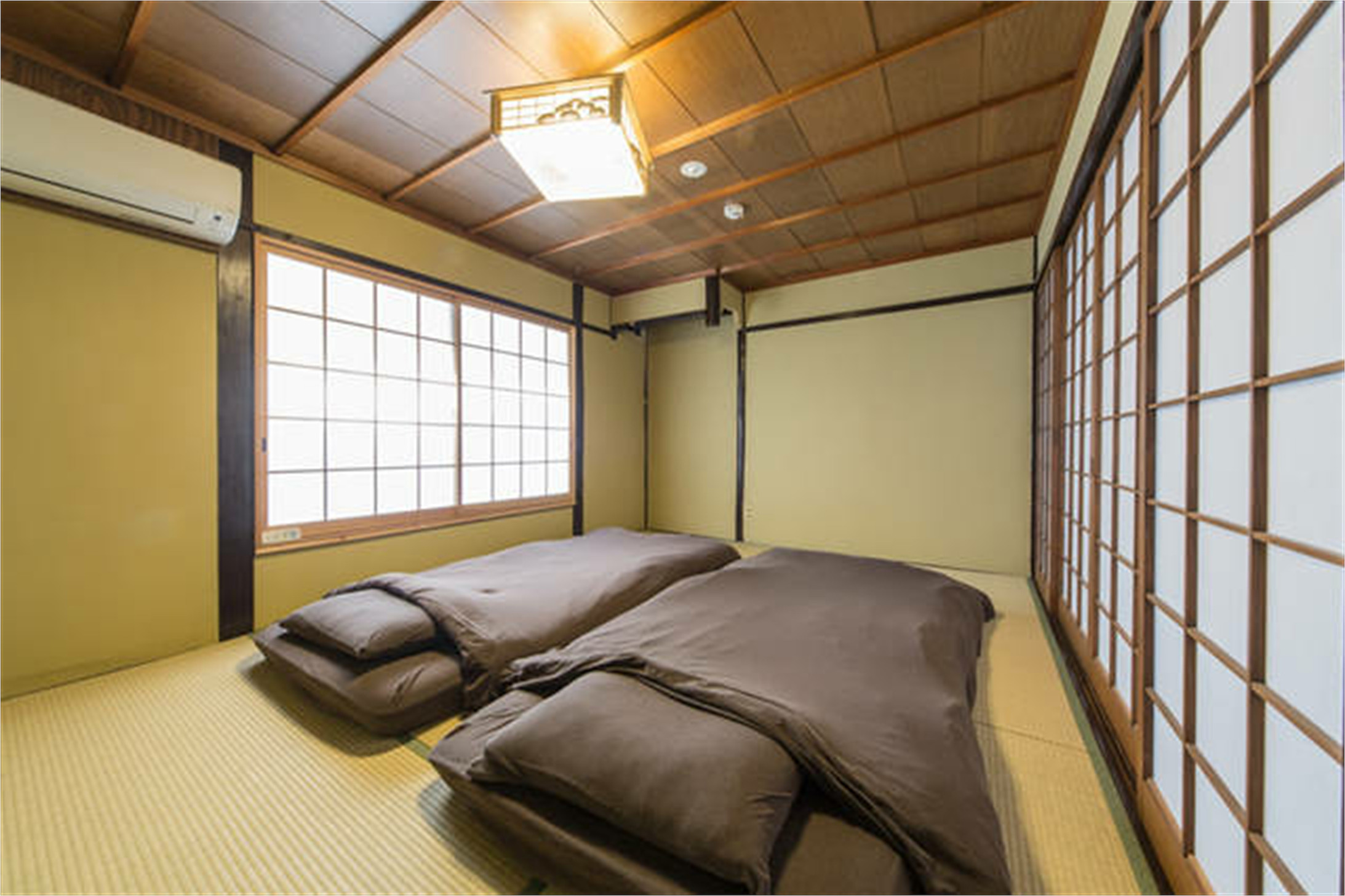
As you can imagine, a stay in a machiya is like living in the past; a way to experience Japanese life as millions live it to this day. The rooms are small, the space tiny, compared to U.S. homes, and the machiya have an undeniable charm and feeling of being IN Japan in a way that a hotel room simply does not capture.
The Floor plan of Juichi-AnSleeping Area, Juichi-An
Our days are spent out and about in Kyoto visiting shrines and temples, shops and museums. Our evenings will be spent in this traditional home. We bring food from the local market, prepare it in the kitchen, and eataround a table sharing our experiences of the day.
Our time in Japan will capture your imagination and offer a perspective on the city few people ever get to experience.
Dining Area, Juichi AnWhat’s Nearby…
After these days in Kyoto, you will leave with a real appreciation of the city, Japanese culture, and the history of this remarkable place. Are you ready for the adventure?
As I have shared in the past, traveling across the world presents some special and very unique challenges when weight limits are less than 40 pounds. In fact, I am fascinated by the fact that much of what we carry is often redundant to our experience. In years past, I have taken both too much and too little. Getting just the right balance takes some practice.
Traveling minimally and well requires practice. Most of that practice can happen at home in a bedroom, packing and repacking clothing, gear, and etc. The thing is, however, we often make the same choices over and over again often refusing to limit the numbers of shirts, pants, or skirts we take along for the ride. My daughter says, “I need choices!” Exactly! Yet having too many choices can lead us to a more stressful experience once the travel has begun!
The trick is to take exactly what you need and not one thing more. Literally not one thing more.
I start with the best bag for travel. The one that I settled on is the EBAG. The site I use is www.ebags.com and it includes just about everything you need to pack efficiently. Similarly, I have used the web site One Bag to hone my packing skills. Combing these two sites and the information included, I have been able to pack well for a three week trip using one bag.
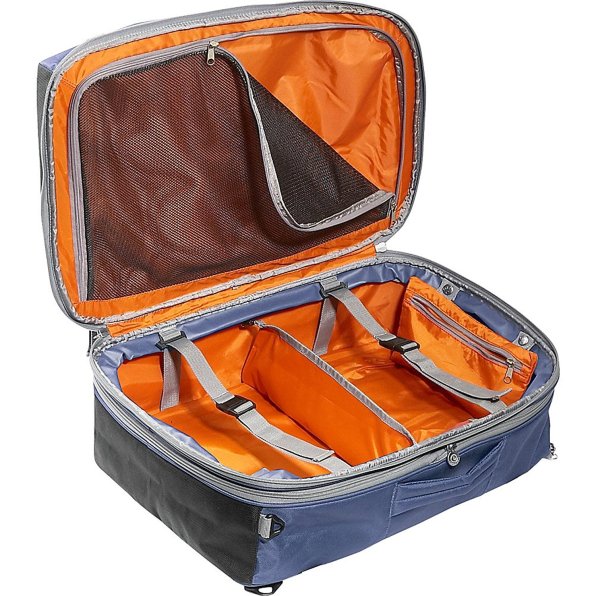
The bag I use is the TLS Motherlode Weekender (yea, I know). Here is what this bag has that others do not…or at least, do not do as well: an outside front pocket for easy access to papers, journals, pens, etc. An inner sleeve for a laptop or other large electronic device. Top pocket for essentials. A single open space used for packing all clothing and etc. The other nice feature is that the backpack straps completely disappear in a inner pocket, making the bag easy to toss on the top of a bus or van when you have to make sure that your bag doesn’t get hung up on someone else’s luggage.
TLS Motherlode Weekender
Notice that FRONT pocket? Nice feature.
Notice how the interior has a mesh pocket on top and straps with a central fabric divider….I’ve never used the divider, and it lays flat for packing.
Interior View
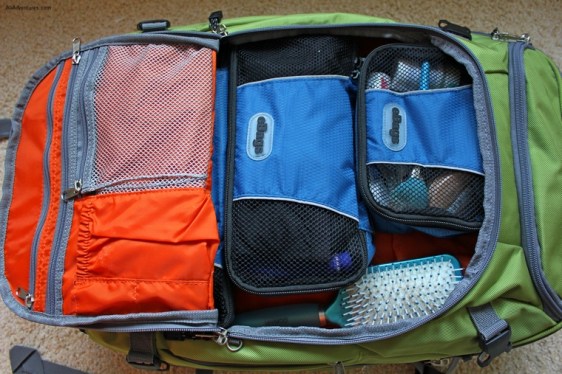
The key, however, to packing well is packing cubes. These lightweight, zippered containers make getting all of what you need IN the bag.
Check out the packing…efficient.
Using this method of packing cubes, the right bag, and the one bag approach to packing, you CAN get what you need in a bag that is easy to carry anywhere, anytime.
Can you see I’m already excited to get on the plane and head to Bhutan? I begin my packing process months in advance, knowing what weather I will encounter and getting any items I need to make the trip easy for me. As trip leader, that makes a huge difference in both my experience and the experience of my fellow travelers. Making sure I have what is necessary positively impacts everyone’s trip.
For the longest time I have wanted to bicycle around Kyoto and this year the plan is set. Bicycling in Kyoto is one of the easiest ways to see the sights in the city and do it in such a way that you can be at street level everywhere. Traveling by bicycle, in any city, is a way to actually see more and experience more than by walking or bus. Here’s my reasoning; on a bicycle you can cover more ground than by walking AND since you are traveling a a reasonable speed, you have the chance to see what you are passing. By bus, the city flies by from street to street and it’s hard to be a part of knowing the city well.
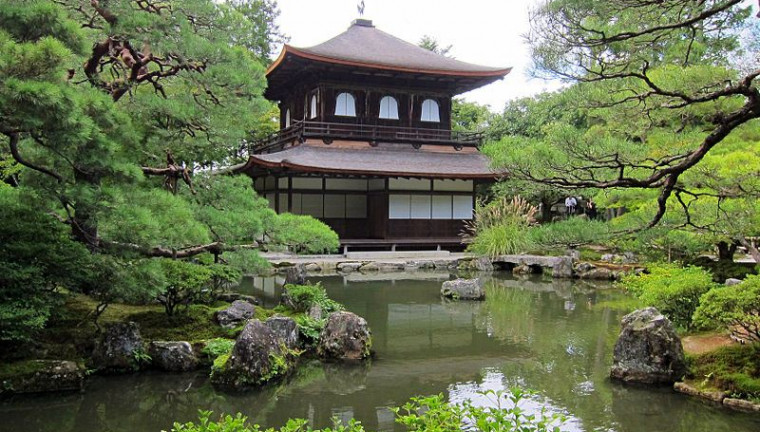
Ginkaku-ji Temple
In Kyoto, our plan is to ride to each of the sights on the plan by bike. Our first ride will be from the bike rental shop on the Kamo-gawa River to Gingakuji Temple. The park around the temple is wonderful and this trip gets our first step into traditional Japanese culture.
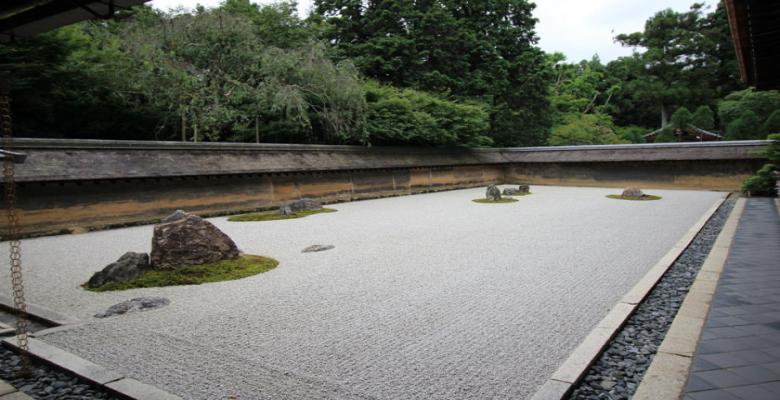
Kinkaku-ji TempleRyoan-ji Garden
Our second excursion will take us around the city proper and to a series of locations including Nijo Castle, the home of the Shoguns, then on to the Hirano Shrine and along the road to the famous Kinkakuji Temple. From Kinkaku-ji we head to the wonderful Ryoanji temple and rock garden. These sites are among the most visited in the city and are worth the time spent. Along the way we will stop for snacks and make a leisurely day of being in this remarkable city,.
Of course, to participate in this adventure, you will need to be comfortable on a bicycle, be familiar with riding near traffic, and be careful to watch each other as we ride through the city. Keep in mind that modest dress is required for the visiting some of these sites. (More on that later)
I grew up in the film era. By film, I mean film photography. Sure, movies were (and some still are) constructed using film, however, my experience comes from shooting 35 and 120 MM black and white film. While I have maintained my interest in and development of film, I was seduced by the dark side: digital photography for a while. OK, so yea, digital photography is NOT some kind of short cut to photography; however, the lessons I learned in film photography are not necessarily inherent in digital photography…..with cameras that adjust for any light source or environmental conditions, the shot is all about the snapshot….with no concern for the number of shots left or cost, digital photography can expand into a near video shoot of still scenes. Even the iPhone has a software feature that takes stills photos and gives them a slight video feel.
Beginning a few years I ago, I decided to re-establish my film photography. I shot film in Japan in 2008 during a trip to the country and found the process really enjoyable. I left behind the strong desire to “see” my instantaneous image and instead relied on my knowledge and instinct to grab the shot I wanted. More recently, I committed to the Hasselblad and 120MM photography. My partner gave me a Hasselblad 500 C/M as a wedding gift in 1997 and I am forever grateful for Katie opening the door to medium format photography. The Hasselblad really forces me to slow my photographic process waaay down…I spend time using a light meter, framing the shot, and clicking off one of 12 stills on a single roll.
The other less talked about but equally important part of working with a medium format film camera is the weight of the beast. With a 50MM lens attached to the camera, the Hasselblad weighs in at almost 6 pounds. Add to that a bag to carry film, film backs, and an extra lens and BOOM serious weight considerations! Just holding the camera is a real trick; on a recent trip, I noticed about 5 out of 60 shots completely out of focus….probably because of shaking during the shoot.
One of the more interesting parts of modern film photography is that IF you want to share images with folks electronically, you have to scan those images. I’m lucky in that I have a place to develop my film for free; however, getting that film into digital form takes real effort. A flatbed scanner is the cheapest solution, AND the time commitment is huge; in my case, roughly 3-5 minutes per scan! Commercial scanning is available and runs roughly $20 per roll (with development)! Yikees!
Enough drivel for today; on to the show! Included here are a few images from last summer’s trip to Japan and Bhutan. I am still processing film and scanning images…these photos give you a glimpse into both the process and the place.
For those interested, all of these images were shot on Ilford HP5 in 120MM format with the Hasselblad 500 C/M, 80mm lens.